
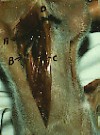
This picture depicts the venous drainage in the neck of piglets.
A: the cephalic vein. This drains into:
B: the external jugular vein
C: the internal jugular vein
B and C anastomose and form the communal jugular vein
D: the end of the sternum (manubrium), marked in black
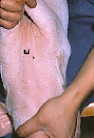
In pigs weighing less than 50 kg it is an advantage to collect blood further caudally (and more medially) in the jugular groove, nearer the manubrium. Depending upon the puncture site, angle and depth of penetration, blood will be collected from one of the vessels depicted in the previous picture. It is difficult to say with certainty which vessel is punctured. An assistant can hold pigs up to about 20 kg on their lap. The assistant holds the forelegs in one hand, and the animal's head in the other. The manubrium and puncture site are marked in black.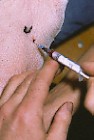
For pigs of this size it is a good idea to use a syringe and needle. The needle is fastened and filled with anticoagulant. For piglets, needles of 23 gauge should be used, while 22 gauge needles can be used on slightly larger pigs. When the needle has penetrated the skin, the operator should aspirate as he gentlly pushes the needle forwards. Blood should be apparent after 10-25 mm, depending on which vessel is punctured. As soon as blood flows into the needle, it should be held firmly to avoid further movement. The operator can place his hand on the pig as shown to steady the needle.
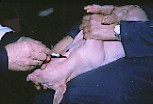
This picture shows venepuncture on a smaller pig, photographed from the side. The pig lies between the assistant's thighs, and only the head and forelimbs are held. The head must not be stretched too far backwards, as this impairs air flow through the throat region.
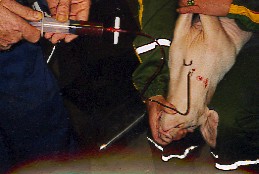
For ease of blood collection, and to avoid problems if the pig is restless, the needle may be connected to a plastic tube.

Pigs weighing between 20 and 50 kg can either be held on their backs in a 'trough' or immobilized with a snout rope as shown on the picture. This pig weighs about 40 kg. The manubrium is marked in black.
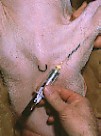
The cephalic vein can be used for blood collection in newborn piglets and weanling animals. It will only be possible to withdraw small amounts of blood from animals weighing less than 10-15 kg. When they weigh 20-50 kg, it is possible, with some training, to withdraw blood nearly as quickly as with the other methods described here. The pig is laid on its back in a 'trough'. The forelimbs are extended backwards and slightly out from the animal. This position allows the vein to extend in more of a straight line and it becomes more accessible. The vein and manubrium are marked in black.
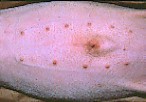
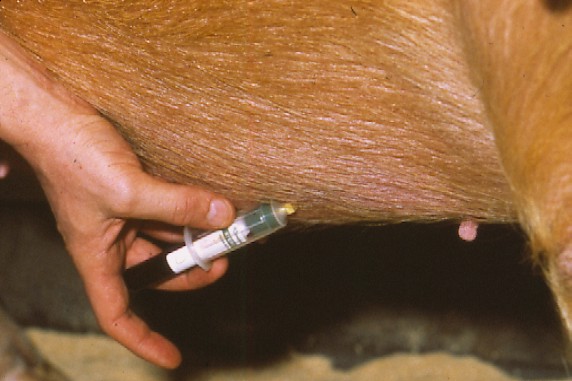
The milk vein (the subcutanous abdominal vein) is easily visible lateral to the teats on smaller pigs. The animal in the photograph weighs about 30 kg. The vein travels subcutaneously on the lateral part of the abdominal musculature. The vein can often be palpated as a groove in this muscle.
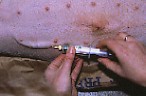
For blood sampling a vacuum tube and a 20 gauge needle is used. The needle is inserted where the vein is most visible. On the picture it has been inserted in a cranial direction just lateral to the second teat. The vein appears larger in this photograph because of a small haematoma. The vein fills maximally during expiration, a wave of blood is often seen as expiration begins. It is often an advantage to bend the needle slightly at the point where it joins the plastic needle holder, so that the holder remains above the skin. In this way the operator avoids sticking too deeply.
Pigs weighing more than 50 kg must be immobilized as described earlier using a snout rope. The vein is palpated and the skin is punctured at the point where the vein is felt most clearly. The vacuum tube is then connected and the needle is carefully moved around until the vein is punctured. The photograph shows a young sow. The operator is standing on the animal's right side and inserts the needle rostrally. This is usually considered to be the best position for right-handed operators. On the animal's left side it is usually easiest to insert the needle caudally.
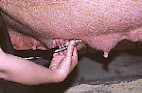
This photograph shows an old sow after weaning. The vein is punctured between the mammary glands. This is where the milk vein is easiest to palpate. The vein may be hidden by the glands on sows with well-developed udders. In pigs from about 5 months of age and upwards it has been stated that it is possible, with training, to obtain enough blood for serological investigations in about 90% of cases. The technique has the advantage of being relatively easy to learn, and the operator is slightly further away from the noise source! In some sows it is possible to collect blood using this technique without any form of immobilization while they are lying down or standing in their pen.
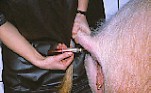
The medial caudal vein lies in a groove under the tail, next to the artery. The operator raises the tail with one hand and punctures the vein with the other. Vacuum tubes and 20 gauge needles are used. The puncture site is at the first freely movable tail joint. This is around the fifth tail vertebra. In adult pigs the needle should be inserted at an angle of 45 degrees to the skin. In smaller pigs it is recommended to hold the tail nearly horizontally and to stick the needle in nearly parallel to the skin.
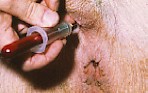
This photograph shows a close-up of blood collection in the medial caudal vein. It is difficult to obtain large amounts of blood even in large pigs. The artery lies right next to the vein, and arterial blood is not uncommonly collected instead. There is, however, no undue risk in taking blood from this site.
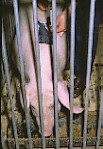
In experiments where it is necessary to take frequent blood samples, it may be desirable to insert a permanent venous catheter. This may be placed in the external jugular vein. The catheter is inserted under general anaesthesia, and is tunnelled dorsocaudally to the neck, using a metal rod. The catheter is led out through the skin via a small incision. It is then possible to take blood samples without disturbing or stressing the animal.
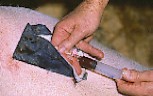
The end of the catheter can be hidden in a small bag sewn onto the skin. The bag can be opened and closed as required (the bag is homemade). After blood withdrawal the catheter is rinsed with a heparin solution. The catheter can also be used for injections or infusions.
萬物蓬勃的7月里迎來了2022年ANTOP獎的申報和評審工作。由島津企業管理(中國)有限公司申報的“3CoinONE全新體驗氣袋進樣器”ANTOP獎進入專家評審階段。獎項名稱:3CoinONE全新體驗......
青島青源峰達太赫茲科技有限公司研發團隊在國際頂級期刊《TrendsinBiotechnology》(譯名:《生物技術趨勢》)在線發表題為“THzmedicalimaging:frominvitroto......
安進宣布,美國FDA授予其在研firstinclass單抗bemarituzumab突破性療法認定,與改良FOLFOX6化療方案(亞葉酸鈣、氟尿嘧啶和奧沙利鉑)聯用,一線治療FGFR2b過表達和HER......
2007年,中國科學院金屬研究所研究員張志東在英國《哲學雜志》(PhilosophicalMagazine)上發表論文,提出兩個猜想,并在猜想基礎上推定出三維伊辛模型的精確解。被《哲學雜志》審稿人評價......
磷酸甘油酸突變酶1(PGAM1)通過其代謝活性以及與其他蛋白質(例如α平滑肌肌動蛋白(ACTA2))的相互作用,在癌癥代謝和腫瘤進展中起關鍵作用。變構調節被認為是發現針對PGAM1的高選擇性和有效抑制......
《NatureChemicalBiology》雜志在線版一篇文章介紹,伊利諾斯州立大學JohnA.Gerlt博士率領的研究小組研制出一種新途徑,能夠確定氨基酸序列已知的蛋白的結構和功能。這是首次利用計......
摘要:本實驗用HCl-HNO3-HF-HClO4消解樣品,KI2MIBK萃取火焰原子吸收分光光度法連續測定土壤樣品中的痕量Cd、Tl、In、Ag。方法檢出限:鎘為0.0052μgPg,鉈為0.0156......